


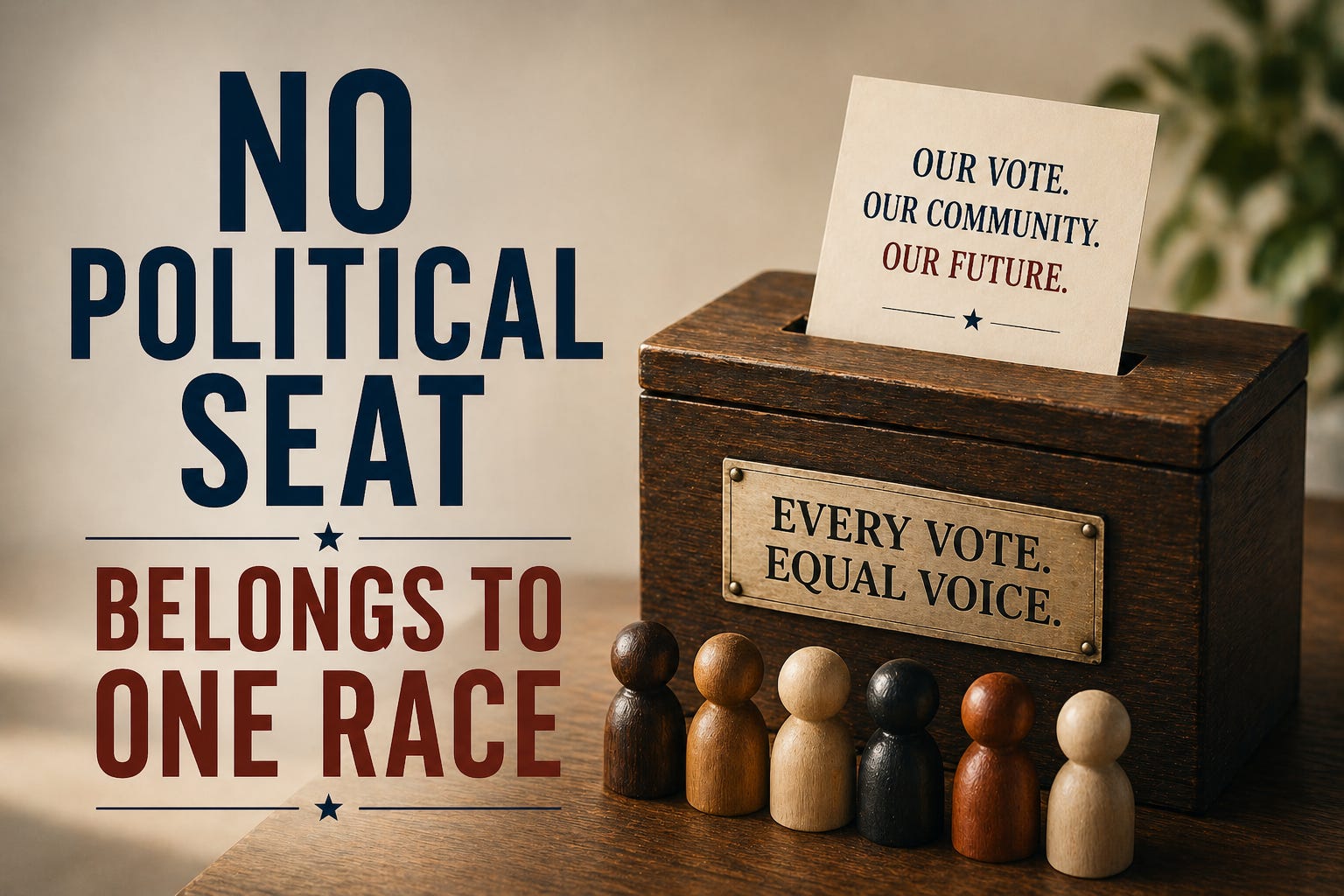
There is a line in politics that should never be crossed. In one of our elections in Grand Prairie, we are watching that line disappear. The implied practice of treating entire demographic groups as predictable voting blocs has erupted into open entitlement, where the right to hold office is viewed as belonging to a group, not earned by an individual. The dangerous principle that an elected seat can be an inheritance—something to be maintained within a particular demographic—is now overriding the democratic process.
The District 3 Election and a Dangerous Precedent
The most egregious expression of this entitlement is currently playing out in the District 3 City Council election. In any open race, the expectation should be straightforward: candidates run, and voters decide. Instead, we are witnessing a troubling effort—both through direct outreach and in public conversations—to encourage voters to cast ballots for Mike Del Bosque, a candidate who is no longer alive. What’s even worse is that this effort appears to be coming from an incumbent candidate running for school board.
Del Bosque was first elected to this seat in 2019 and, after filing for reelection earlier this year, passed away unexpectedly in March. Because the filing deadline had already passed, his name could not be removed from the ballot (In contrast, in a separate school board race, Nancy Bridges also passed away, but did so before the filing deadline closed, allowing her name to be removed).
This is happening in a race with two perfectly capable living candidates. What is being encouraged here is not outreach—it is something else entirely. It is an effort to influence the outcome of an election by directing votes toward a candidate who cannot serve. Multiple Grand Prairie residents have reacted to this in blunt terms: grotesque. It undermines the basic promise of an election—the ability to choose a viable representative.
According to multiple sources who asked to remain anonymous, the reasoning behind this approach has been framed in the following way: voters were originally presented with three candidates, and now they are left with two, neither of whom is Latino. From that perspective, the seat should remain represented by a Latino candidate. The proposed path forward, as described by those sources, is to secure a majority of votes for Mike Del Bosque; in Grand Prairie elections, he would need at least 51% to win. Because he is deceased, such an outcome would not result in him serving, but could instead trigger a special election—one that would allow time for an alternative candidate to emerge. (As a side note, special elections cost the city around $30,000). Even if presented as a matter of fairness or representation, that approach fundamentally changes the purpose of the election itself. It shifts the focus away from choosing among the candidates who are actually running and toward engineering a different outcome altogether.
With Hispanics now making up the majority of the population, the irony is hard to ignore. The very dynamics that many have worked to move beyond—judging leadership through the lens of identity rather than merit—are reappearing in a new form. When any group, regardless of background, begins to frame public office as something that should be maintained based on identity rather than earned through open competition, it undermines the very progress that made broader representation possible in the first place. It sends a message to voters that their role is not to evaluate candidates as individuals, but to align with a predetermined expectation. That is not empowerment. It is a different version of the same problem.
Because most voters are not making decisions based on race. They are asking far more practical questions: Who can lead? Who can solve problems? Who can represent their interests? And those interests—public safety, infrastructure, public services—have little to do with the color of someone’s skin. (In Grand Prairie, it has more to do with socioeconomic demographics, but that’s a topic for another article.)
When the conversation shifts away from those realities and toward preserving identity in a seat, it begins to erode trust. Not just among one group, but across the entire community. Because public office is not an inheritance, it is a responsibility that must be earned—every single time.
Let’s be clear: casting a vote for a deceased person is a profound betrayal of the election process. It has real-world procedural consequences, replacing the finality of a voter-decided race with the maneuvering required for a later appointment. This fundamentally compromises the way representation is achieved in our city. Grand Prairie is a diverse city, but diversity does not mean uniformity. No community is a monolith; Hispanic voters are not a single bloc, and neither are Black, White, or Asian voters. Residents bring their own experiences, priorities, and expectations to the ballot box, and they deserve to be treated as individuals—not as predictable outcomes.
At the local level, most concerns are far more practical than political narratives suggest. A pothole does not care who fills it. It does not care about race, party, or identity, nor the racial makeup of the household it sits in front of. What matters is whether the person in office can actually do the work to get it fixed.
When Campaign Messaging Changes by Audience
A similar pattern can be seen in how campaigns are communicating with voters. In recent days, campaign text messages sent by a city council incumbent to different groups of voters have revealed a noticeable shift in emphasis. The core message remains the same—public safety, infrastructure, fiscal responsibility—but certain elements are highlighted or omitted depending on the audience. In some cases, identity-specific initiatives are prominently featured. In others, they are absent altogether.
That raises a reasonable question: Is tailoring examples to different audiences simply effective engagement—or does it cross a line when identity becomes the primary lens through which voters are addressed?
Because there is a difference between speaking to a community and reducing that community to a single defining characteristic. There is a difference between representation and assumption. And when that line is crossed repeatedly—across campaigns, messaging, and even election strategy—it begins to reinforce the very problem many residents are reacting to: the sense that voters are no longer being treated as individuals, but as racial categories to be managed.
When political campaigns choose to focus on dividing voters by identity rather than uniting them on issues of results and competence, they fail the community. When the line is crossed between legitimate outreach and cynical entitlement, confidence is shattered. Voters disengage, and the damage extends far beyond a single race, creating lasting doubts about the integrity of our local government. Public office is not something to be maintained; it is something that must be earned, every single time. The moment this principle is replaced by entitlement, we are undermining the very representation we claim to be strengthening.