


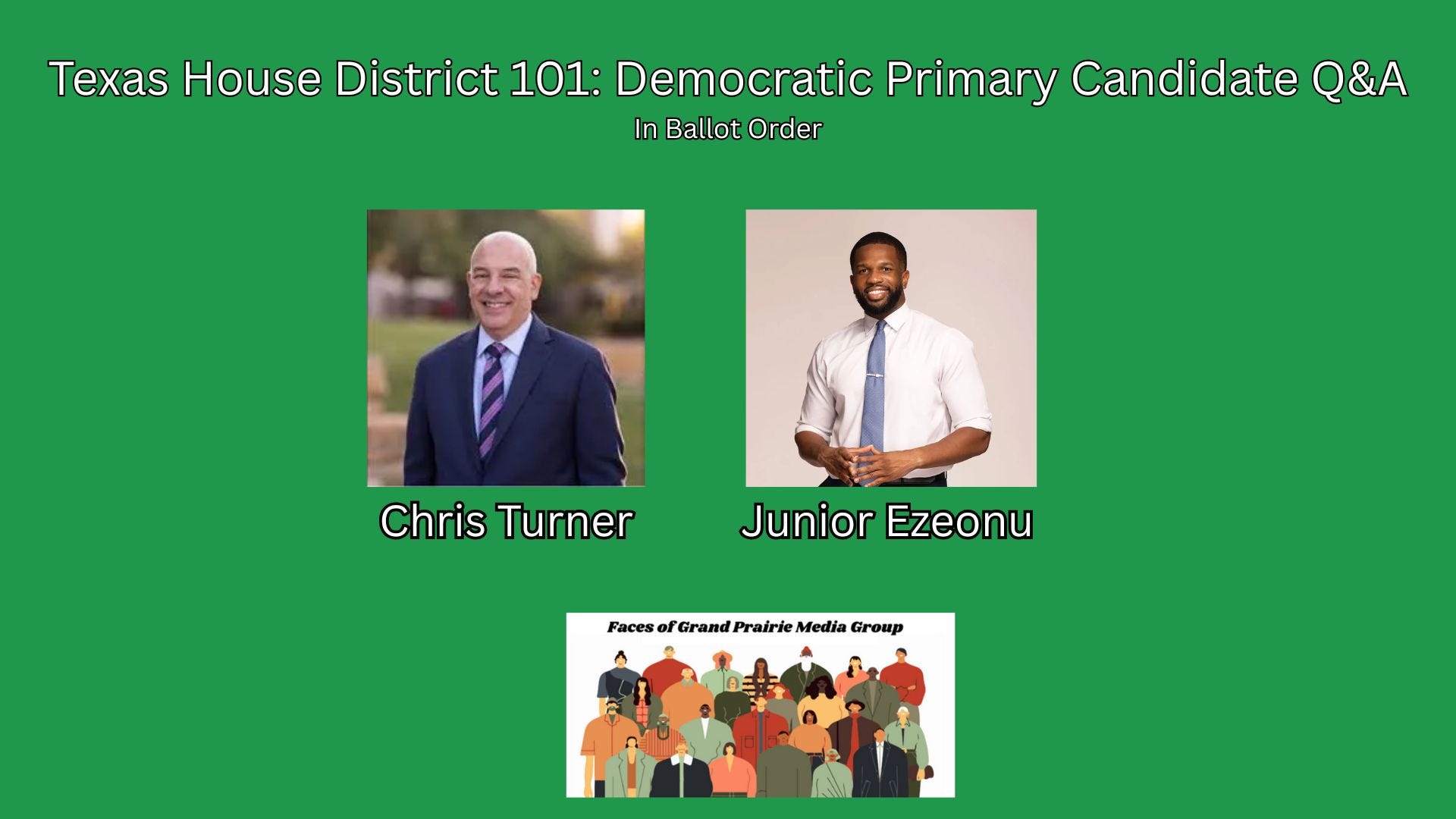
Both candidates were invited to participate in this written candidate forum and were provided the exact same questions, with the opportunity to respond in writing. The responses below are presented in official ballot order. Nothing has been edited; each response appears exactly as submitted by the candidates.
Early voting for this primary race begins February 17, with election day on March 3.
Chris Turner

1. What specific state laws or policies would you prioritize changing or introducing in your first term, and why?
a. If re-elected, my most important policy priorities include expanding Medicaid, repealing private school vouchers, fully funding our public schools, and increasing the minimum wage.
Equally important policy priorities include issues that specifically affect the HD 101 community, including my continued work to ensure that the Tarrant Appraisal District does not jeopardize our local public school funding, and legislation to further reform group homes to ensure the vulnerable population they serve is treated with the proper care and expertise.
2. How do you balance the needs of House District 101 with broader statewide priorities when those interests conflict?
a. As a state representative, it is important for me to work on both big picture priorities to improve the lives of Texans across the state and local issues that have specific importance to District 101 residents.
Often, these responsibilities overlap and I am able to fulfill both at the same time. However, if these needs conflict with one another, because I know I am the sole representative in the Texas House who is elected and duly sworn to represent the people of HD 101, the values of my constituents always take precedence. This is a responsibility I take seriously and remain committed to fulfilling.
3. What House committees would you seek to serve on, and how would that benefit this district?
a. Throughout my tenure in the House I have served on various committees, spanning topics from Redistricting to Higher Education, and I have found that no matter what committee I was a part of, there were always opportunities to serve my constituents.
The past two sessions, as a senior member of the House, I had the privilege to serve on two highly sought-after committees — State Affairs and Ways and Means. On State Affairs, I had the opportunity to vote on bills to increase the capacity of our electric grid, bills proposing regulation of THC, and to be the first line of defense against a myriad of discriminatory and harmful bills proposed by Republican lawmakers.
As a member of Ways and Means and as Chair of the Committee on Property Tax Appraisals, I supported legislation increasing the homestead exemption, fought against and defeated increases to our state sales tax, and passed legislation requiring our appraisal districts to follow the law and not harm our public school funding.
4. How do you evaluate whether a bill may have unintended consequences before casting your vote?
a. When casting my vote, I aim to take in as many perspectives on the legislation as possible to ensure I have a solid understanding of the legislation and to understand all impacts the bill will have. I read summaries of the bill developed by the House Research Organization and Legislative Study Group and review the committee report to see which individuals and organizations testified for and against the bill.
Oftentimes, if I am still undecided or have concerns, I will reach out to witnesses who testified on the bill, or to experts on the bill’s subject area who I have developed relationships with over the years. If I am not sure how the bill will affect my community, I reach out to representatives for the cities I represent, our school districts, or the local entity, community, or neighborhood that the bill would impact.
5. What is one vote you anticipate taking that may be unpopular but that you believe would be necessary?
a. While it is impossible to know what exact bills we will be voting on, I cast votes every session that may prove to be unpopular. It would not surprise me to see Governor Abbott bring back some of his failed policies from last session, such as punitive bail measures that strip away due process from the accused and are patently unconstitutional, as well as so-called property tax relief bills that unfairly tie the hands of local governments. It is not politically popular to be against those measures, but I opposed them before and will vote against them again.
6. How should the Texas state budget reflect the continued growth of districts like House District 101?
a. As the sole member representing District 101, it is up to me to ensure that the state budget provides fair funding for our community. That includes funding for the University of Texas at Arlington, funding for our parks such as Fish Creek Trail or Tyre Park and sidewalks, funding for the upkeep and expansion of our roads, and, most importantly, sufficient funding for our public schools.
In preparation for every legislative session, I discuss specific budget needs with the cities I represent to make sure I am advocating for items in the budget with the greatest need.
Lastly, we must expand Medicaid, which can be done as an amendment to the state budget. Expanding Medicaid would immediately provide health insurance to over one million Texans, including many residents in HD 101. It would also save insured HD 101 residents money because their premiums would no longer be used to subsidize care for uninsured patients.
For many residents, there is more month than money, and with increased tariffs and other economic issues affecting how far our dollar can go, I am committed to doing everything I can to help ease the financial burdens imposed by their state government.
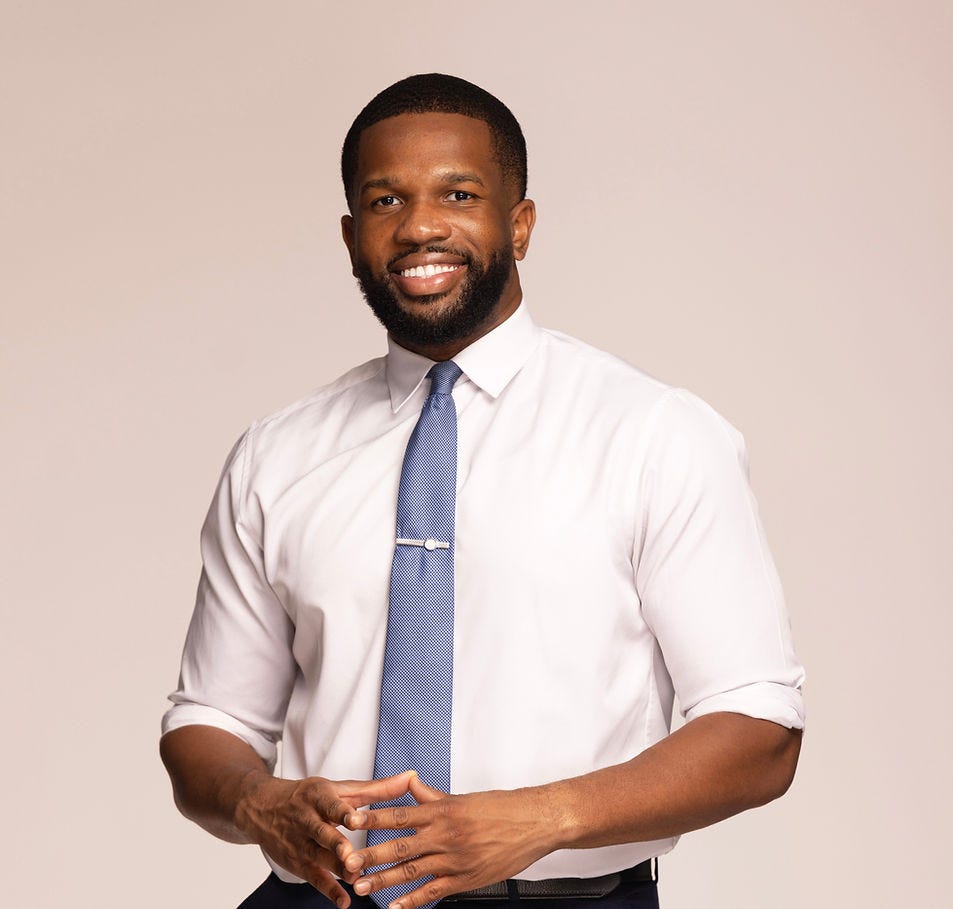
Junior Ezeonu
https://www.votejuniorezeonu.com/
1. What specific state laws or policies would you prioritize changing or introducing in your first term, and why?
a. I would prioritize raising the state minimum wage from $7.25/hr to $15/hr through a phased-in approach where it increases by $1.55/hr annually until it reaches $15/hr after the 5th year. At that point then we should tie the minimum wage to the annual inflation rate so wages keep up with increases in cost of living.
b. I would propose a bill that bans private equity and institutional investors from buying single-family homes. Homeownership is out of reach for most Texans and it is true that there are several causes for this. But by banning institutional investors we can ensure that more Texans have an opportunity to compete in the market against other individuals and not corporations looking to turn neighborhoods into rental properties.
c. I would propose a bill that repeals SB 840, which allows multi-family developers to build on commercial or industrially zoned lots without requesting zoning changes. This law has caused a lot of frustration for residents and local leaders in suburban cities that want to have input into how their communities are developed. I don’t believe that leaders in Austin know what is better for local communities than their locally elected leaders and engaged residents.
d. I am vehemently against the private school voucher law that was passed last legislative session and would propose a bill to repeal it and provide more funding for public education while making sure that our public schools focus the funding on teacher pay and resources to improve the education of our students.
2. How do you balance the needs of House District 101 with broader statewide priorities when those interests conflict?
a. This is a great question. My job as an elected representative for House District 101 would be to prioritize the needs of my community and district first. There will be times when there will be legislation that is important to our state as a whole or to my political party, but I would have to make sure that I protect the interests of my district first.
3. What House committees would you seek to serve on, and how would that benefit this district?
a. Public Education and Trade, Workforce and Economic Development.
i. House District 101 serves families and students that primarily attend Arlington ISD, Mansfield ISD and Grand Prairie ISD. Ensuring that our public schools are properly funded and that all students have an opportunity to thrive and excel is a priority for me, so I would be honored to serve on that committee.
ii. It would also be important to serve on the Trade, Workforce and Economic Development Committee as we see all of the growth and opportunities that are coming into our district. The policies that are shaped within this committee would greatly impact my constituents both in the present and in the future, and I believe it would be very important that I serve on this committee.
4. How do you evaluate whether a bill may have unintended consequences before casting your vote?
a. I would evaluate if a bill has unintended consequences by meeting with key stakeholders on both sides of the bill, listening to the input of my constituents and analyzing the positive and negative outcomes of similar pieces of legislation in our state or in other states.
5. What is one vote you anticipate taking that may be unpopular but that you believe would be necessary?
a. None come to mind at the moment but as an elected official I will do my best to prioritize the interests of my constituents in every vote that I take. I will be responsive, honest and forthright with why I make the decisions that I make and explain my thought process on key votes.
6. How should the Texas state budget reflect the continued growth of districts like House District 101?
a. The Texas State Budget should include increased funding for infrastructure projects to support the growth of districts like House District 101, but also increased funding for public education and prioritizing opportunities to allow the DFW to become more interconnected through public transit projects.